Cri du Chat awareness week 2018 (Day 3)

Cri du Chat Syndrome can’t be cured but with love, therapies and family support, our kids have a chance to reach their full potential!

From the 5p- Society website

Treatments

Occupational therapy

Occupational therapy benefits our kiddos by providing fine motor, visual perceptual, self-care and sensory integration intervention to assist the child/young adult to maximize their skills, develop new skills and be able to relate more effectively to the environment around them.  Occupational therapists who work with children have education and training in child development, neurology, medical conditions, psychosocial development, and therapeutic techniques.

Physical Therapy

Children with Cri du Chat syndrome may experience physical difficulties during their growth and development. Physical therapy can help your child’s physical development in the following ways: helping them to sit, stand, improve fine motor skills, etc. The goal of physical therapy for children is not to speed up the rate of their development, but to facilitate the development of optimal physical movement.

Speech Therapy

Speech therapists work with children from an early age to aid in swallowing by providing advice on what best methods exist for feeding. As children with Cri du Chat syndrome grow older, they may experience problems with their speech. Speech therapists provide guidance on assisting children with communication issues by utilizing and teaching different methods of communication such as: sign language, picture exchange system, technology assisted communication, etc.

Alternative Therapies

Many families have found the use of alternative therapies as a way to complement Occupational, Physical and Speech therapy.  Here is a list of therapies that other children and/or adults with the syndrome have benefited from:

▪ ABA Therapy (Applied Behavior Analysis)

▪ Adaptive Physical Education

▪ Aromatherapy

▪ Aquatic Therapy

▪ Behavior Therapy

▪ Cranial Sacral Therapy

▪ Dolphin Therapy

▪ Hippo-therapy (also known as Horse Therapy)

▪ Music Therapy

▪ Play Therapy

▪ Pragmatic Group Therapy

▪ Sensory Learning Therapy

We have tried many therapies and activities over the years.

One of Emily’s favorite is Hippotherapy although I am fairly certain that if Dolphin Therapy was available around here, she would make us buy her a membership for life 

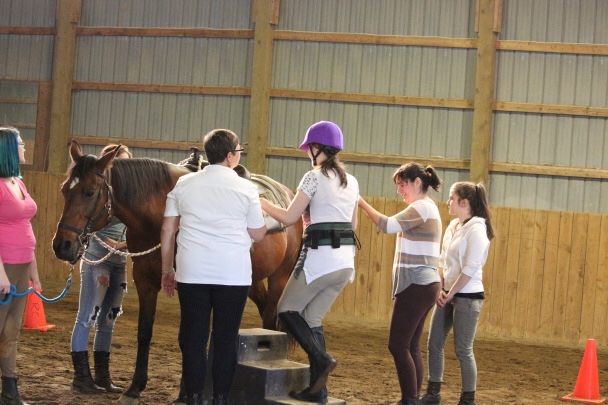
We have a facebook page: If you want short updates and timely pictures of the little things that are happening in our life, please like and follow Lessons from my daughter‘s page.

You can also find me on Twitter at @plebrass

Cri du Chat awareness week 2018 (Day 2)

Cri du Chat Syndrome is a big unknown for many doctors and therapists out there.

We (the parents) know that this is a spectrum and that the diagnosis we receive is worst case scenario but many doctors still believe that our kids will accomplish nothing.

If you’ve been following Lessons from my Daughter for awhile, you know Emily is a young adult and she is doing a lot of things!

She is her own person and regardless of the challenges, she continues to move forward, she continues to learn and grow!

Here is what you can find about the development of kids with Cri du Chat Syndrome on the  5p- Society website

Development

Here’s some things to look for when it comes to development with 5P- syndrome.

▪ Gross and fine motor skills

▪ Expressive speech and language delays

▪ Communicate by sign language, communication devices, gestures and a few basic words

▪ Poor muscle tone (hypotonia)

▪ Slow growth associated with failure to thrive

▪ Constipation

▪ Low Birth weight

▪ Normal Life expectancy

▪ Young adults may have premature graying

▪ Most children walk, although at a slower pace and with a guarded gait.

▪ Majority of children do not achieve toilet training.

▪ Many children and adults have sleep issues.

▪ Some have visual problems.

▪ 80% of children have a hearing condition known as hyperacusis (hypersensitivity to noise).

▪ Children with CdCS undergo typical changes in puberty at the appropriate age

▪ Many children have seizures ranging from Grand Mal to silent.

▪ Very few adults are able to work with supervision.

▪ Even fewer adults are able to live independently.

▪ Most children with CdCS have behavioral issues

▪ Attention Deficit Hyperactivity Disorder (ADHD).

▪ Poor concentration.

▪ Impulsiveness and OCD.

▪ Biting, hair pulling, pinching and hitting.

▪ Temper tantrums, stubbornness, frustration, self-biting, head banging and skin picking.

▪ Autistic-like characteristics- some are dually diagnosed with Autisim.

▪ Hand flapping, string twirling and rocking.

As you can see, there is a wide range of challenges, not all kids face the same struggles but all of them do face some struggles.

Our kids have faced more challenges in their young life that many people will face in their whole life.

Regardless of the struggles, issues and challenges…

Emily is still smiling and laughing!

Emily continues to learn and grow!

Emily will not let her syndrome define her and all the kids I have met with Cri du Chat Syndrome are the same…

They define Cri du Chat Syndrome!

We have a facebook page: If you want short updates and timely pictures of the little things that are happening in our life, please like and follow Lessons from my daughter‘s page.

You can also find me on Twitter at @plebrass

#CruduChatSyndrome